|
By Cary B - 8 Years Ago
|
This latest version of Iclone has brought with it some tremendous improvements in many different areas. Yes, there are still some glitches and features that don't work the way they are supposed to, but overall a very impressive and ambitious upgrade. With all of that there is a lot of stuff to learn (or re-learn on occasion).
The latest episode of my animated graphic novel, Those Who Walk in Darkness, is completed. It was animated entirely in Iclone 7. I see improvement in a lot of areas, both from the software and from my own work.
But, I'm also aware that I am not skilled enough to use the software to its full potential. I have a lot of learning to do. Still, the story is getting told, and I can see my work is getting better. Hope you enjoy this latest effort:
EPISODE 4: THE WINDING FLOWS
|
|
By Rogue Anime - 8 Years Ago
|
|
@S.S. Well, I could go on for 20 minutes about your feature, but I'll instead just say, "WOW!" What an enormous amount of work! Excellent ~V~
|
|
By GOETZIWOOD STUDIOS - 8 Years Ago
|
|
Indeed, a lot of work you put in this. Respect!
|
|
By toystorylab - 8 Years Ago
|
Yo, impressive qua result and amount of work...
Well done!
|
|
By justaviking - 8 Years Ago
|
Wow! Totally epic.
Such a great cliffhanger. When will the next episode be release?
|
|
By Peter Blood - 8 Years Ago
|
Very nicely done. Your efforts are paying big dividends in your animation and story-telling. I enjoyed it immensly.
:cool: pete
|
|
By Cary B - 8 Years Ago
|
Thanks for your encouragement and response. Next episode is written and has one scene animated, but tough to say when the final release will be.
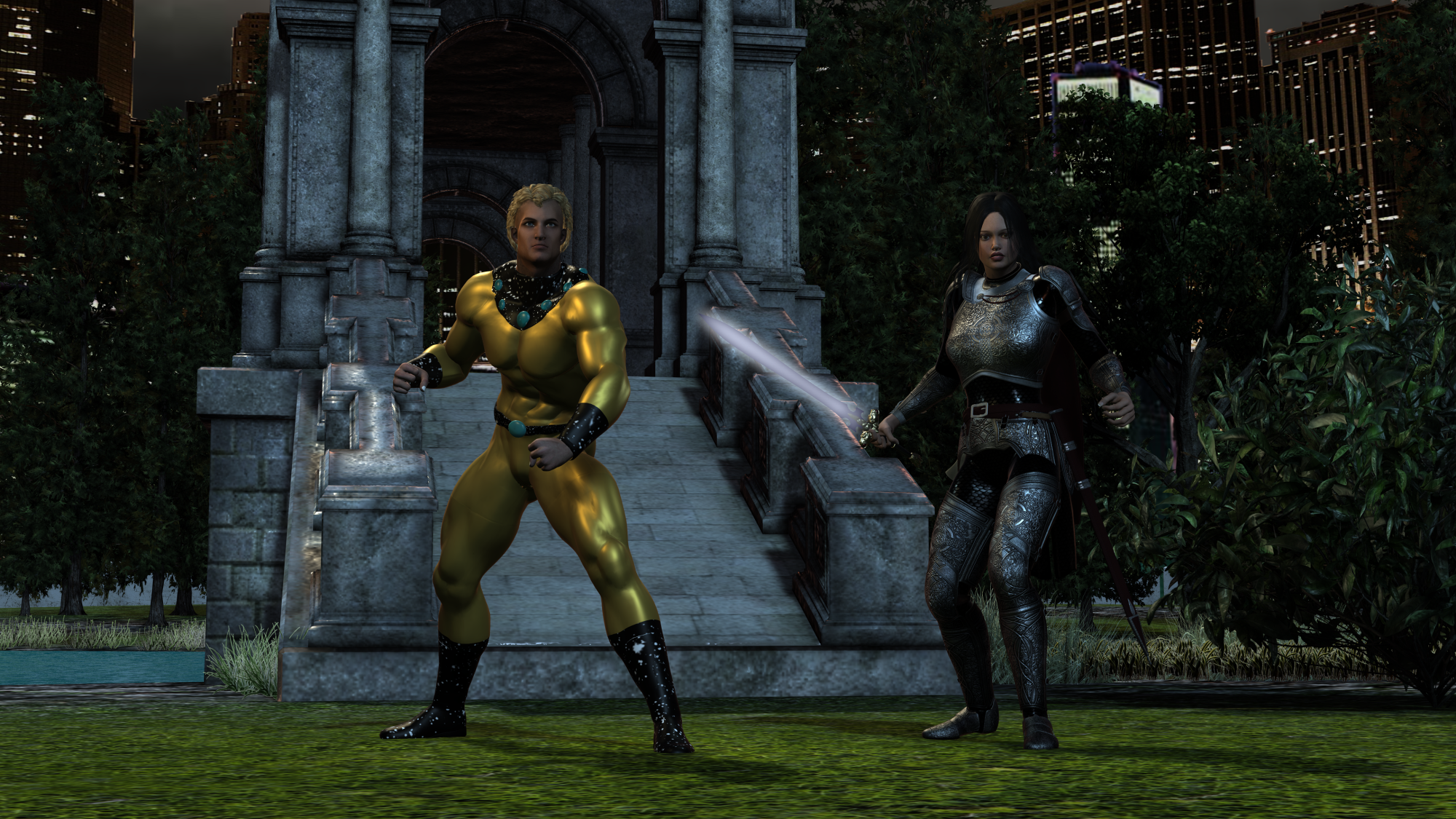
I\ll post a few shots from the current episode...here Questar and Gabriela explore the eerie grounds of London's Highgate Cemetery.
|
|
By mark - 8 Years Ago
|
Reminds me of the great Saturday Morning cartoons shows I loved so much!!! Great job!!!
|
|
By Cary B - 8 Years Ago
|
Mark, I can't tell you how much I appreciate your gracious encouragement. I recall how much your "London Flyover" tutorial inspired me and showed me a glimpse of creative possibilities for Iclone I hadn't realized. I stole ideas from it shamelessly.
And your videos have such style and flow, and interesting visual storytelling. So, thanks for showing us what this little animation program is capable of.
|
|
By Cary B - 8 Years Ago
|
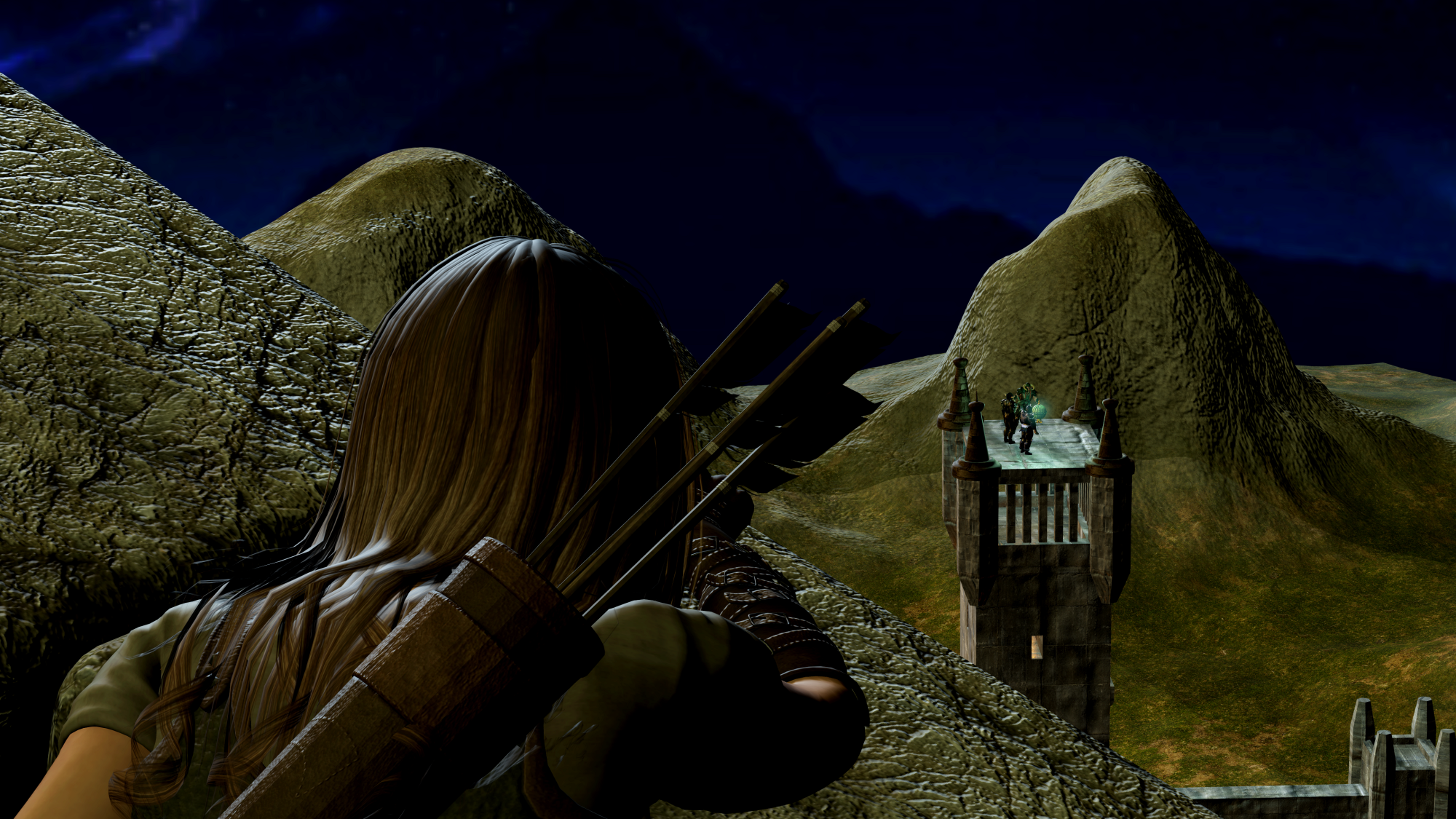
Here's another shot from the current episode: Lyssa the Archer spies on the villains from her mountain perch.
|
|
By rogyru - 8 Years Ago
|
30min animation that's one hell of a workload . Well done you must have put a great deal of effort in to this
|
|
By Cary B - 8 Years Ago
|
Royyru, thanks. Yeah, a lot of work. But it's a fascinating learning experience and fun to do.
But you made me curious about something. What is your philosophy for deciding when you are done with a scene? (This is a general question for anyone).
My goal is focused on telling the story, having it progress, not necessarily on doing the absolute best animation. So, if I'm struggling with a scene, and I can't iron out all the animation issues, I wind up just doing the best I can and move on. I can be something of a perfectionist about certain aspects, but if it's beyond me, then I just go on.
Months later, as my skills increase, I might look back and see how I could have solved the particular issues in a better way. But by then I'm onto some other scene, keeping that story progressing.
So how do you approach an animation project? I'm sure it differs as to the type of project, but when do you decide a scene is finished? For me there are always things that can be tweaked, but I don't let myself linger too long.
I
|
|
By GOETZIWOOD STUDIOS - 8 Years Ago
|
|
Shadoesword (2/17/2018)
../.. But you made me curious about something. What is your philosophy for deciding when you are done with a scene? (This is a general question for anyone)../..
In the professional world, deadlines and money are taking care of that question ;) You can't have indefinite retakes or else the movie would never be released.
But you, as an hobbyist or independent, have no real limits, you are the sole judge of what is good or good enough. I don't know in English but in French we have a saying: "The best is the enemy of good"
And in fact, that's the job of a Director to know where to stop or not. You have to "see" where you want to go. You must have a "vision" of your movie.Easier said than done though.
I have a question for you: Did you created all your shot directly ?
Because there are a few things that can help you answering your question, things that are used in professional film-making. For instance, instead of doing your shots directly you can first do animatics or previz. That is a rough version of your movie without final rendering nor animation, just camera blocking but with some sound and music, and dialog, even if those are not from the final voice talents. Like an animated storyboard. This helps having a anticipated perception of the rhythm of the movie through editing, detecting what will work or not in advance, having an overview of the entire movie before it is done so you will be able to "feel", hopefully, if it will work or not.
This is at this stage you can test several approaches for a scene, try different framing, camera motion, etc.. Hopefully at some point you'll have a version that seems to work, that you like. The biggest question imho is: Will it work for the audience ? Then you can start to create your final shots and at this point don't look back. Follow your animatic. The final result will be a milestone of your Art, don't try to correct it, then once done, move on to the next project, which will be probably better anyway.
Then 10 years later you can create a new version of that previous movie and you will call it a remake ;)
|
|
By justaviking - 8 Years Ago
|
grabiller (2/17/2018)
Shadoesword (2/17/2018)
../.. But you made me curious about something. What is your philosophy for deciding when you are done with a scene? (This is a general question for anyone)../..In the professional world, deadlines and money are taking care of that question ;) You can't have indefinite retakes or else the movie would never be released. But you, as an hobbyist or independent, have no real limits, you are the sole judge of what is good or good enough. I don't know in English but in French we have a saying: "The best is the enemy of good" And in fact, that's the job of a Director to know where to stop or not. You have to "see" where you want to go. You must have a "vision" of your movie.Easier said than done though.
I totally support Guy's comments about TIME and budget. Working on some sort of project (such as the "Pinhead" projects that crop up on this forum) are a great way to complete a project, regardless of its final quality.
And yes, the question for perfection (or even "better") can result in a project that is never finished and never shared with the rest of the world, and that's sad.
For instance, instead of doing your shots directly you can first do animatics or previz. That is a rough version of your movie without final rendering nor animation, just camera blocking but with some sound and music, and dialog, even if those are not from the final voice talents. Like an animated storyboard. This helps having a anticipated perception of the rhythm of the movie through editing, detecting what will work or not in advance, having an overview of the entire movie before it is done so you will be able to "feel", hopefully, if it will work or not.
I have often said that a lot of my work is best considered "pre-viz." :P That's okay, since I really like telling the story, and I'm not seeking a million views on YouTube.
Many other things I do reside in the "proof-of-concept" category. I'm fine with that, too, since I see iClone (and other s/w) as a technology toy and a place for learning stuff.
All that works well for me, since I try not to spend 40+ hours per week on iClone in addition to my full-time day-job at the expense of ignoring my wife and kids. Oh, it does happen once in a while, but I try not to make it a constant way of life.
|
|
By Cary B - 8 Years Ago
|
|
grabiller (2/17/2018)
I have a question for you: Did you created all your shot directly ?
Because there are a few things that can help you answering your question, things that are used in professional film-making. For instance, instead of doing your shots directly you can first do animatics or previz. That is a rough version of your movie without final rendering nor animation, just camera blocking but with some sound and music, and dialog, even if those are not from the final voice talents. Like an animated storyboard. This helps having a anticipated perception of the rhythm of the movie through editing, detecting what will work or not in advance, having an overview of the entire movie before it is done so you will be able to "feel", hopefully, if it will work or not.
This is at this stage you can test several approaches for a scene, try different framing, camera motion, etc.. Hopefully at some point you'll have a version that seems to work, that you like. The biggest question imho is: Will it work for the audience ? Then you can start to create your final shots and at this point don't look back. Follow your animatic. The final result will be a milestone of your Art, don't try to correct it, then once done, move on to the next project, which will be probably better anyway.
Then 10 years later you can create a new version of that previous movie and you will call it a remake ;)
Yeah, your point about the remake is well-put. My thoughts exactly!
But I admit, I just don't see an advantage to creating a rough previz for an Iclone movie. For a real-world project, I can see that previz would be vital in having a lot of the work done before all the actors and technicians are around. Saves money and their time. You just go in and you've got your choices already made and you know what will work. Iclone itself, as I understand it, is a good tool to use for previz of real-world films.
But in Iclone, you aren't working with anyone else anyway, so I don't see why you don't just use all your assets to begin with. Maybe I'm missing something, but it seems like if something is not working, you're going to be better able to tell if you are using all your animation assets.
I have a script I'm working from, and as I'm creating the shots I do try different camera angles, movements, etc. Sometimes I re-pace a piece of dialog to make it work better. I tweak the camera movements with the curve editor, re-frame shots, slow down or speed up, tweak lighting, and when it feels good, I render it. Sometimes I do some of the early animation in "quick mode", which I suppose could be thought of as a kind of "previz" in a way.
But if I'm understanding you correctly, I would be doing all these things in the previz stage in rough form, then loading in the real assets and executing the whole thing again according to the choices I made. That seems like a lot of extra work. Or am I not getting it?
|
|
By justaviking - 8 Years Ago
|
|
Shadoesword (2/19/2018)
But I admit, I just don't see an advantage to creating a rough previz for an Iclone movie.
Consider these two scenarios...
a) If you do a previs enough to be firm in your camera angles, you can avoid creating assets that will not appear in your shots. You don't see what is behind the camera man. In a room, there might be no need for that bookshelf filled with books and knickknacks and paintings on the wall, etc.
b) You might also determine the complex, detailed keyframing work you planned on doing no longer fit the story. It may have looked good on paper (script), but just doesn't flow on-screen. So perhaps you saved yourself 20 hours of work, and thus it is easier to throw things on the cutting room floor because you are less invested in them.
Restating my comments about my own projects, I'm not very efficient with iClone, and "real life" gets in the way of my hobby, so I usually don't have time to polish things like landscape, clothing, lighting, lip sync, and so on, so my final project tends to be closer to a previs quality than that of a well-tuned masterpiece. That's my excuse, and I'm sticking to it.
|
|
By GOETZIWOOD STUDIOS - 8 Years Ago
|
@Shadoesword
This is an interesting discussion that should probably take place in a Filmmaking section of the forum ;)
I get what you are saying, and I see your point, indeed, when working alone it is very tempting to take shortcuts, I am experiencing that myself for my current project and I try to restrain myself to take any shortcuts like this.
That said, I'm not saying doing previz or animatics is the answer to your initial question, it was just a suggestion. If you feel comfortable with your current method and if that works for you then by all mean do not change anything, of course.
As you said, in the professional industry, doing animatics or previz is kind of mandatory in order to plan ahead the work of all the teams involved in the production of the movie. This indeed save time and money but nonetheless it also helps the director to have a better vision of his final film before being completed. Waiting for the film to be completed for a director to then "know how" he will then do it is a syndrome we are fighting against on a daily basis with some directors, and of course it is a big NO from the production, in general.
Let's summarize the 4 main advantages of doing previz/animatics for a "real-world project":
- Saving time
- Saving money
- Allow team coordination
- Allow better artistic choices by anticipating the final result
Well, when doing a iClone film you get the same advantages.
Of course, you have the luxury to go all the way through your final shot, then change a thing or two, the perhaps restart from scratch because you don't like it, add a new camera angle, perhaps change completely the animations (you prefer that background character to be drunk instead of running because he his late..), etc.. Again, if that works for you that is perfectly ok. But if you think about it, why wouldn't you benefit from the same advantages as for "real-world" projects after all, and perhaps complete your movie in 3 months instead of 5, for instance ?
You said it yourself you have been through hell creating your long sequence shot and now that it is finished, even having to do a small correction may be discouraging. Perhaps if you did a previz of it at first you would have more easily spotted what works and what's not. May be not, I don't know, I can't answer for you, again this is just a suggestion and an invitation to think about it.
If you decide to change the animation of your drunk background character into something else, perhaps at first you bought the drunk animation, and now you don't need it anymore because you prefer having a character running. So you would have wasted money.
But these are "micro-changes" - that may make you waste time and money nonetheless, despite being "micro".
Most importantly, and to me this is the most fundamental reason to do animatics/previz, is that having your all movie as a previz or animatic is the only way to detect any needed "macro-changes" before you spend all you money, time and most importantly your patience.
Things like changing the structure of the story, perhaps even changing part of the story, because after seeing the all movie as an animatic/previz you may realize that something does not work in the emotions, or the action, or the intrigue, etc.. You feel that the movie is too long or too short, that the editing does not work nor the music you planned to use, perhaps even a voice talent or even an actual character. Cutting shots once the movie is done because this is needed for the good of the movie is the most heart-breaking thing that can happen to a director. So if you have done shots that are already "final" and then at the end you decide to cut those shots, all the time spent to create those shots in their "final" state would have been wasted.
But again, that may not work for you, if you need to see the shots or movie in their "final state" in order to make those decisions and changes then so be it, that would be perfectly ok because you are the Director of your own iClone movies, you are in charge.
|
|
By GOETZIWOOD STUDIOS - 8 Years Ago
|
@Shadoesword
I forgot to mention an important thing:
If you don't create a previz or an animatic, how do you decide of the length of each shot ?
(Which implies how much work you will put in each shot?)
|
|
By Cary B - 8 Years Ago
|
|
[b]justaviking (2/19/2018)
a) If you do a previs enough to be firm in your camera angles, you can avoid creating assets that will not appear in your shots. You don't see what is behind the camera man. In a room, there might be no need for that bookshelf filled with books and knickknacks and paintings on the wall, etc.
b) You might also determine the complex, detailed keyframing work you planned on doing no longer fit the story. It may have looked good on paper (script), but just doesn't flow on-screen. So perhaps you saved yourself 20 hours of work, and thus it is easier to throw things on the cutting room floor because you are less invested in them.
.
Maybe it's just a matter of workflow and terminology because I can't see either of these two scenarios happening the way I work. I guess the first one is possible, in some degree. I have created my own sets, especially the London scenes where I downloaded a bunch of London buildings from Sketchup, and then placed them according to a Google map of London. (this idea stolen directly from Mark's great "London Flyover" tutorial). I went a little crazy creating my model of London, and wound up not using some sections I had built. But previz wouldn't have been of help in that instance. It was not the camera shot that wouldn't work, it was my limited skills in model building. I was visualizing using my model in a grand flyover of the city, and if I could have gotten the model like I wanted it, the camera shot would have been no problem. But my vision was just too complicated to execute with my limited skills in model building. I did use a number of sections from my model, and used a longshot that contained many of the model elements.
The set is where I start in my workflow, deciding if it needs to be a full 360 degree set, or if I can get away with something less. If it's a big battle scene, I know I'll need the 360. If it's maybe a shot between two characters talking that's not connected to a larger scene, I may have a set that is less than 360, and confine my camera shots. Often my sets are DAZ sets that are fully 360. I might tweak the sets in some ways. For example, in some of the London scenes I had a 360 Daz street scene ... but I changed some of the street signs to be London traffic signs instead of American ones. However, I didn't make those changes until I knew a particular sign was going to be in a shot. I would plot out my camera shot for a scene, and if a sign showed up that needed to be changed, I would do it at that point.
So, cutting to the chase, my general workflow is
1. Choose the set
2. Assemble characters in the scene in general positions
3. Set up camera shot for the scene (this involves experimenting and playing around)
4. Tweak any issues with the set that will be in the shot
5. Add in dialog and do lip synch and facial expressions
6. Animate the characters that are in the shot ( I may well have some animations in mind beforehand, but maybe not)
7. Tweak the camera shot to accomodate any changes the animation may have caused
8. Do the lighting
9, Watch the scene play several times and tweak anything that seems to be an issue
10. Render
Sorry for the long post...
Anyway, I do understand your points about the time it takes to create a scene in Iclone, and the need to live a life. I am semi-retired, or I would never have the time to mess with this hobby. Even so, it's often times hard to get the time I'd like. ;)
|
|
By Cary B - 8 Years Ago
|
|
grabiller (2/19/2018)
@Shadoesword
I forgot to mention an important thing:
If you don't create a previz or an animatic, how do you decide of the length of each shot ?
(Which implies how much work you will put in each shot?)
I am not sure I totally understand your question. I decide the length of each shot based on the dramatics, the mood, the pace of that particular moment...what is needed to tell the story and make things clear or enhance the emotional impact. I mean, that's the ideal, I don't claim to achieve it. It's definitely a subjective process, but that's where the fun and the art comes in.
That said, when I am rendering a shot, I generally render a little more than I expect to need just in case I feel I need to stretch it out a bit when I'm doing the editing.
|
|
By GOETZIWOOD STUDIOS - 8 Years Ago
|
Shadoesword (2/20/2018)
grabiller (2/19/2018)
@Shadoesword
I forgot to mention an important thing:
If you don't create a previz or an animatic, how do you decide of the length of each shot ?
(Which implies how much work you will put in each shot?)I am not sure I totally understand your question. I decide the length of each shot based on the dramatics, the mood, the pace of that particular moment...what is needed to tell the story and make things clear or enhance the emotional impact. I mean, that's the ideal, I don't claim to achieve it. It's definitely a subjective process, but that's where the fun and the art comes in. That said, when I am rendering a shot, I generally render a little more than I expect to need just in case I feel I need to stretch it out a bit when I'm doing the editing.
From what I understand from your workflow, you work on a shot by shot basis ?
I mean you have your story or script, and you decide what will be the first shot, you do it, then the second shot, etc..
Or do you create some sort of storyboard or something first ?
In short, do you plan ahead all your shots or do you just imagine those on a shot by shot basis, sequence after sequence ?
|
|
By Cary B - 8 Years Ago
|
|
Sorry, some weird double post thing happened.
|
|
By Cary B - 8 Years Ago
|
|
grabiller (2/20/2018)
From what I understand from your workflow, you work on a shot by shot basis ?
I mean you have your story or script, and you decide what will be the first shot, you do it, then the second shot, etc..
Or do you create some sort of storyboard or something first ?
In short, do you plan ahead all your shots or do you just imagine those on a shot by shot basis, sequence after sequence ?
Well, it varies a bit. Generally I conceive things in a sequence of shots. The opening of the last episode, for example, starts with a slow zoom-in toward a planet in space, which is then identified by text. Then a quick zoom transition takes us to the surface of the world where the camera is still zooming across the city...another quick zoom transition takes us inside a specific building on that world where the camera is still zooming to a specific figure. So there are three separate shots there, but conceived in my mind as a single sequence. I don't know the specific camera angles for each shot before I start work on the first one, but I know I want them to match in terms of zoom speed and pacing, to feel as if they are one shot.
When the dialog begins, it drives the pacing. And I conceive of sections of dialog not as a single shot but as a sequence of related shots. Mostly you want the camera to focus on the character speaking. But different pacing and shifts in attitude may require different camera angles. For example, in that first scene, the Black Templar talks about betrayal in the heart of one of the guards... and while he's talking to the guard, the camera moves around him to focuses briefly on the guard's reaction to what he is saying, only to come back to a close shot of the Templar for the final "punchline" of his speech. This was conceived as a single sequence, even though several shots are involved. But I don't know the exact camera angle for each shot until I get in and start experimenting.
In my script sometimes I indicate specific sequences of shots, which was the case with the opening. But more often I just describe some basic action and add in the dialog, and build the sequences as I go along. But I do have a good deal of experience in video production and in comic book writing, so I have a decent understanding of visual storytelling. I already have a fairly good sense of what's likely to work and what won't. I'm sure I could benefit from some film classes, and I may get around to that. But a big part of my goal here is to have fun. :P
|
|
By Rampa - 8 Years Ago
|
An animatic, or storyboard, is essentially just a simplified version of the end result. So if your not changing mediums, like digital animatic to filming on set with actors, you would keep refining and adding to your animatic until it is the final product.
I think most iClone users work this way.
|
|
By GOETZIWOOD STUDIOS - 8 Years Ago
|
@Shadoesword
I'm afraid I didn't get your last two messages ?
-- UPDATE --
I got it know, you were probably editing the message :)
|
|
By GOETZIWOOD STUDIOS - 8 Years Ago
|
|
Rampa (2/20/2018)
An animatic, or storyboard, is essentially just a simplified version of the end result. So if your not changing mediums, like digital animatic to filming on set with actors, you would keep refining and adding to your animatic until it is the final product.
I think most iClone users work this way.
I'm not sure about that.
It seems lots of iCloners start their first "version" with final assets and rendering. Refining is then done on final data, lighting, animations, etc.. But they start "heavy" right from the beginning.
The difference with true animatics is that you don't use final assets, so you can work much faster.
For instance you can animate a character that has no skinning but only dummy partial limbs parented to bones, so you can have 20x or 50x time the number of characters in your scene when working the animations. (this is valid far beyond the animatic step, at the actual animation step too, you don't need the final assets to create the final animations, you only switch to the final assets at render time).
|
|
By GOETZIWOOD STUDIOS - 8 Years Ago
|
|
Shadoesword (2/20/2018)
Well, it varies a bit. Generally I conceive things in a sequence of shots../..
Ok, so from what I understand you create your movie scene by scene (in the script order), and when you start working on a scene you have a pretty clear idea of the sequence of shots you want for that scene.
Shadoesword (2/20/2018)
../..In my script sometimes I indicate specific sequences of shots, which was the case with the opening. But more often I just describe some basic action and add in the dialog, and build the sequences as I go along. But I do have a good deal of experience in video production and in comic book writing, so I have a decent understanding of visual storytelling. I already have a fairly good sense of what's likely to work and what won't. I'm sure I could benefit from some film classes, and I may get around to that. But a big part of my goal here is to have fun. :P
Yes your videos clearly show that understanding, there is no question about it. I'm not here to criticize your Art, but to propose one (among others) suggestion that may help answering the question: "What is your philosophy for deciding when you are done with a scene?".
That suggestion states that as long as you don't have a global vision of your final movie it is difficult to decide when you are done with a single scene. When you have an animatic/previz version of your movie with almost final editing, dialogs, music and some sound design then you can quite clearly see if a scene is working or not, too long or too short, lack of rhythm, bad camera work, mood, etc.. It does not help for final lighting and rendering of course, nor for final animation, but that a start that helps a lot.
But again, if you are not comfortable with the idea, that's perfectly ok.
Just for the fun, have you tried this: You take your latest completed movie and watch it again, from start to finish, several times and then ask yourself: "Ok, that's my finished animatic. Now, what about the final version of my movie ?" (this is a vicious mind game/exercise I know ;))
|
|
By Cary B - 8 Years Ago
|
grabiller (2/20/2018)
I'm not here to criticize your Art, but to propose one (among others) suggestion that may help answering the question: " What is your philosophy for deciding when you are done with a scene?".
That suggestion states that as long as you don't have a global vision of your final movie it is difficult to decide when you are done with a single scene. When you have an animatic/previz version of your movie with almost final editing, dialogs, music and some sound design then you can quite clearly see if a scene is working or not, too long or too short, lack of rhythm, bad camera work, mood, etc.. It does not help for final lighting and rendering of course, nor for final animation, but that a start that helps a lot.
I appreciate it, Guy, I don't take it as criticism. This forum I have found is one which is mainly encouraging in its tone. But my question wasn't meant to say that I can't decide when I'm finished with a scene. It was meant to say that others might have a different philosophy than mine -- which is not to spend hours and hours trying to get scenes perfect, but to get them to the best level I can achieve without investing overmuch time. I would rather keep the episodes progressing than try to get everything perfect.
My storytelling is basically meat and potatoes, straight ahead, not too fancy, not a lot of creative shots like using reflections on a rain-spattered window and the like. It doesn't fit my genre, for one thing, And my creativity tends to work in a different direction.
But some people love the artistic elements and want to get those details perfect, that's a vital part of their expression. So I wanted to spark a discussion about the balance between getting a scene finished and the push for perfection. It's an interesting topic to me. Like most of us, I suspect, I've been on both sides of it at different times.
I do appreciate your suggestion on previz, and maybe I am just not seeing its value in Iclone because I can't quite conceive of how it would work. How do you set up your previz scenes in Iclone? What elements do you use and which do you ignore for the rough stage? What is your workflow for previz?
|
|
By Delerna - 8 Years Ago
|
|
What is your workflow
Only took that part of the quote because for me that is the primary thing I like to see for any topic along the lines of this and others mentioned.
For me, the right or wrongness within the way someone works to achieve projects, modelling, animations ...... whatever, is irrelevant. I like to see the workflow of other people. I might see something in someone else's workflow that will help me improve my workflow. Indeed, I have shown my workflows on a couple of topics because I hoped some would see something I did that fitted into their own.
So I agree with you. The sharing of workflows is good to see. Whether I see it as good, average or bad is irrelevant because we are all different.
If anything assists someone else then that makes it worthwhile......especially if it assists me :D
On the topic, I am finding more and more the big leap forward in iClone 7 and a lot of what I find is due to the many discussions in the forum.
I still need to discover storytelling though. Not sure I am ever going to get to doing anything of my own. Just website fan fictions etc that I can animate for my own enjoyment.
Sigh......Oh well
|
|
By GOETZIWOOD STUDIOS - 8 Years Ago
|
|
Shadoesword (2/20/2018)
../.. ../..But my question wasn't meant to say that I can't decide when I'm finished with a scene. It was meant to say that others might have a different philosophy than mine -- which is not to spend hours and hours trying to get scenes perfect, but to get them to the best level I can achieve without investing overmuch time. I would rather keep the episodes progressing than try to get everything perfect../..
I see now that I've, indeed, misinterpreted your question. I was thinking you were actively trying to find an answer to it. My bad, I'm very sorry about that, some times my poor english is playing tricks on me :/
Shadoesword (2/20/2018)
../..So I wanted to spark a discussion about the balance between getting a scene finished and the push for perfection. It's an interesting topic to me. Like most of us, I suspect, I've been on both sides of it at different times../..
I get it now, and yes, this is a very interesting topic.
I believe their is no magic receipt to it albeit in the "real-world" productions there is some kind of "auto-balance" due to time and budget constraints but also because of some mandatory technical level of quality requirements (for instance shots may be rejected by final labs if they are too noisy).
But when you have "all the time" then when or where do you stop ? In fact I think the answer has nothing to do with filmmaking. Take a model maker working on a miniature sailing boats, perhaps sculpting all the details, painting all the pieces. A painter. A cook, an architect, a writer and his book, when or where they decide "it is finished" ? Every where there is some kind of Art, that question presents itself isn't it ?
Now that I better understand your question I'll give you "my philosophy" of how I decide when I'm finished: and my answer is very simple: I first decide where I want to go before I even start the project by picking some references. In my professional work I have a deadline or quotas and a clear idea of the needed level of quality so the decision is pretty straight forward for each shot. For my hobbyist projects, I choose to reach a certain goal. I may decide to create something that globally works in terms of story telling and cinematography even if the technical quality is not very high. Or I may decide otherwise with the help of some criteria like the level of quality of the animation, the rendering quality, post-process, sound design, etc.. and I imagine a global vision or impression of that combination. Then while doing the shots I know quite quickly and clearly if that goal has been reached.
But, most importantly to me, the more vital question I have to answer is: Is the all movie "working" according to my original "intention" (or "vision") ?
(Take an Action Movie: is it boring at the end ? Do we understand clearly the actions ? Is it entertaining ? etc..)
1) If the answer is yes, then whether each shot reach the target goal or not is secondary to me. If I have the time - or the courage, or the patience - then I'll most probably try to enhance those. But if I don't - lets say there is a Movie Festival soon were the movie will be presented - then that is perfectly ok as long as the movie "works". The audience won't accept a movie that does not work, but will be very tolerant if some shots are not as good as some others.
2) If the answer is no, then no matter how good each shot are, the movie won't work and I would have to start over, rethink the story, the plot, the camera work, etc.. (hence the vital aspect of the previz to me).
Shadoesword (2/20/2018)
../..I do appreciate your suggestion on previz, and maybe I am just not seeing its value in Iclone because I can't quite conceive of how it would work. How do you set up your previz scenes in Iclone? What elements do you use and which do you ignore for the rough stage? What is your workflow for previz?../..
I'll detail that workflow in my current project forum thread: "THE SILENT PAST - A Supermachination Project"
But basically, there will be 3 steps or 3 types of iClone scenes:
1) Camera Blocking (Action/Camera Work)
This will be my animatic/previz, with kind of wooden stick figures in order to go very fast on how to setup the action and the camera. This will leads to a edited version of the movie with voices, music and some sound design. I'll only use dummy elements here, no final asset.
2) Layout/Animation (Final Animation)
Then I'll set the final animations with probably an "animation version" of my characters (or perhaps the final character assets if there is no lag or slowing down issue in iClone) and setup the sets.
3) Final Shots (Set Dressing/Lighting/Rendering)
Switch all "animation versions" to their "rendering version". Add all the sets details and accessories. Do the lighting, adding FXs if needed, etc.. Eventually split in several render "passes" (scene too heavy, need for compositing, etc..)
|
|
By justaviking - 8 Years Ago
|
Okay then, about my workflow...
1) I start with a very complete story. It may or may not be thoroughly scripted, but I have a very good grasp of the story I am going to tell.
2) Next I try to find an existing "scene" that looks close to what I need. That could be a simple terrain, or a sample project that comes with iClone.
3) I place my character(s) in the scene and do some initial speech and crude animation. Mostly likely I do all the voices, male and femail. At that point I am essentially blocking out my scene and getting an idea of the timing within that scene. If the character is going to hold a cell phone, and I don't have one handy, I might simply scale down a primitive 3D Block as a stand-in.
>>> INSERTED DAYS LATER...
>>> Steps #2 and 3 are really a combined step of "create a rough layout of the entire project."
>>> That is where I will do some prototyping and proof-of-concept work. If there is some key technique that is important to achieving the vision that's in my head,
>>> and I've never done it before, I want to know now before I go too far. On my long Pinhead "Kidnapped" project, one thing I tested (and incorporated) was
>>> having Pinhead clobber a mailbox with a baseball bat, so I needed to know I could do a plausible animation of pounding with the bat, and severely deforming
>>> the mailbox.
4) If it is an actual multi-scene project, I will repeat steps 2 and 3 as-needed. Along the way I will render each scene, and assemble them in my video editor (NLE). At this point I have what could could almost be considered an animated storyboard. Here I will be able to see if what I have seems to flow like I thought it would.
5) Now I go back and work on various elements of each scene. I tend to use a 'triage" approach, addressing what I see as the most horrifyingly bad things that desperately need to be fixed (or simply need to be done). I might do the same work on multiple scenes, but not necessarily. On one scene I might change the sky from day to night, while on another scene I might decide the character should be sitting outside on the porch instead of inside on the sofa. So I tend to work on the scenes in a random order, based on whatever feels like the top priority.
While doing that iterative improvement, I make notes to myself. It helps me remember things, and it is satisfying to check things off of the "To Do" list.
One of the first improvements is usually the real voice-overs. That way I can animate to the duration of the speech. I might have initially spoken some lines too quickly, but the real dialogue (whether done by me or someone else) might be done more dramatically and more slowly, so a 10-second bit "rough speech" might turn out to be 12, 13, or 15 seconds long.
This step is very iterative. Rather than finish one scene, i try to gradually improve the overall project. Why? I guess i would rather have a crude, but complete STORY than an incomplete one. I don't want to have two excellent scenes with another seven scenes missing.
This iterative approach usually involves a number of updates to the overall project in the NLD. I will also start putting in some music and a few critical sound effects in the NLE.
6) This is where it gets messy. If the deadline approaches, I continue with my "what needs the most attention" approach until I finally have to make my finished cut. All too often I don't polish the lighting (I always want to, but I usually have more critical issues that make watching the video an unpleasant experience), some lip sync might be a bit off, and the sets might still be a bit barren. Camera angles and cutting between cameras is one of the things I think I do tend to complete fairly well.
On a positive note, I do have a complete project. I can show it to people, and I can submit it.
More about Step 5 --- After the initial start, I tend to "spread out" my character animation, meaning I will have a few seconds of extra space between my actions. One person talks, space, another person talks, space, the car drives by, space, a person talks again. I do that because I tend to copy/paste keyframes and put them nearby while editing,, I might want to re-use them, or I might do something I don't like, or whatever. (That's in addition to doing "Save As" frequently.) It also gives me added room if I want to extend an action. As I get more comfortable with the animation of individual elements, I start to tighten those gaps. This is why "Insert" and "Delete" frames on the timeline is so valuable to me. It used to be horribly slow, but has been wonderfully fast for quite a while now (might have been fixed near the end of the iC6 lifecycle, I don't remember for sure, but I'm happy).
One area I think I've improved is my attention to the quality of my vocal track. After I record the lines, that is one thing I complete right away. I do some background noise reduction, and save the lines to many small files, usually a small paragraph each, but sometimes even a single line. That makes it easy to remove some unwanted dead silence or insert a dramatic pause in iClone. (Remember Insert/Delete frames?)
WRAP-UP:
There you have it. Good or bad, I think that's pretty much the way I tend to work on any "real" project that is more than just playing with various bits of iClone functionality.
|
|
By Rogue Anime - 8 Years Ago
|
|
Shadoesword (2/20/2018)
[quote]grabiller (2/20/2018)
I do appreciate your suggestion on previz, and maybe I am just not seeing its value in Iclone
Being actively involved in film & TV production, IMHO the value of 'Previz' is not for iCloners per se' - it's more used in TV/filmmaking pre-production. In this way, primary layouts for every scene are created along with every lighting detail, # of cameras, and their movements/relation to shots in the script, actors placement, marks, and movements - all with the exact set scaling and so on.
In this way, a producer/director shares the project files for the individual units in the production based on the scripting to design the actual production based on all the virtual previz. This streamlines and coordinates all the units in a movie/TV production process between all involved both in the pre-production, production, and post production processes.
To use this for iClone alone would only make sense if you had say, a whole team of folks working on a production in order to assign the different artists their individual tasks and all be able to work with the same project files, as in previz in film/TV use. ~V~
|
|
By Cary B - 8 Years Ago
|
I agree with Delema that there is no wrong or right way to do your projects in Iclone. Everything depends on what your personal goals are and what is fun for you. In a lot of ways, it comes down to how our brains are "wired" differently by our experiences and particular strengths, and what we are used to. If you are a student seeking to develop skills in film making, you are guided by your teacher and you do things according to the process that is being taught. There is value is stretching yourself to do things that are not in your comfort zone. You come out of it with deeper knowledge. I like to consider myself a student, but I'm older now, and I pick and choose what I want to learn based on what my interests are. I know I'll never learn it all.
Guy, you clearly have a lot of experience and technical knowledge, far beyond mine in the realm of animation and film. I am basically a writer and an actor with some background experience in video and audio production. I suspect I process things very differently than you.
I don't always understand what you mean in your posts. For example you have talked a number of times about a "global concept" or things that "work globally".. It sounds to me like you are saying that the previz process gives you a "big picture" vision of the project. It helps you focus on the whole rather than the details, so I guess that helps you unify everything. I get that, for you, it is the composition of the picture before the details are added, sort of the skeleton or foundation.
I think for me, a big part of that process happens when I am writing the script. I do a vague "previz" in my head as I am writing it. I am used to writing comic books, so I am used to writing visually and in visual sequences. Obviously certain visualizations occur to me in the process, some which may work, some which may not. Some moments come with a deep clarity, and I see exactly how I want it to work. More often, the actual visuals are less specific. But in the script writing, I have the "global" aspect of the scene in mind, I know what I want the scene to accomplish and how it relates to other scenes. Sure, sometimes it veers off track and you have to go back and change things, but it's easier to change the script than to re-do an animation, at least for me.
In fact it is the actual animation in Iclone that is the most difficult, frustrating part for me. That's where I have least experience and confidence. Things often don't work the way they seem they should. Motion clips often don't align well, even with the new features in Iclone 7. There are still issues with foot sliding, sudden pops and jerks in transitions, awkward poses, head turns that don't really seem natural, lip synch that sometimes gets off. And sometimes when I try to fix the problems, I only make them worse. I'm getting better, and Iclone 7 is better. But this is where I want to invest my time in learning right now. It's like a basic technical skill that needs to be brought up to a better level before I can delve deeper into the more artistic side of the film making.
Still, growth in all areas happens along the way just by doing it, and by talking about it in forums like these. So I really value hearing everyone's thoughts and considering things I have never thought of. There is scientific research which indicates that creativity is multiplied by exposure to other points of view and other peoples ideas.
|
|
By GOETZIWOOD STUDIOS - 8 Years Ago
|
|
Shadoesword (2/21/2018)
I agree with Delema that there is no wrong or right way to do your projects in Iclone. Everything depends on what your personal goals are and what is fun for you. In a lot of ways, ../..
I believe the ultimate answer is in your second sentence, and if you switch the order of those two sentences you will see the contradiction included in the first sentence.
Granted everything depends on what your (personal) goals are, then there is "right" and "wrong" ways to do your projects. Your goal(s) alone make the way(s) "right" or "wrong". That's the key.
The wording "right" or "wrong" should probably be replaced by "efficient" or "inefficient" though, because those words are more explicit in regard to what's going on then.
Ultimately, it is not because you use the "efficient"/"good" way instead of an "inefficient"/"wrong" way that your final movie will be "good" or "bad", for sure, but most often this helps to avoid errors and mistakes that would lead you away from your "goals", this is what about I have difficulties to explain. And once you are aware of that, it is not because you want to make a "good" movie that you have to use the "inefficient"/"bad" way ;) I know this sound silly but most of the time this is what happens, because the more "efficient"/"good" way almost always appears to be more difficult, more involving because less prone to improvisation, because you then must follow some "rules" and respect some constraints.
Most painters do some sketch first before starting to actually paint. But a genius painter may not need it, because he is.. a genius so he will bypass the sketching step. That's perfectly fine. He would have then used the "inefficient" way, but that's perfectly fine with him. An average painter, if he bypass the sketch step, then will probably produce a average or even less than average painting. But what is his goal ? Most often, the joy and pleasure of having created a painting. That's already something and perfectly ok. But that's not the kind of "goal" I am after. And I believe a lot of iCloners do not have "goals" different than that one.
I'll be a bit rude here but we are all average directors right ? Because if there was a genius one among us we would have detected him a long time ago. We don't have a Ridley Scott in the community, nor a Martin Scorsese or a Brian De Palma, we don't even have a Michael Bay or a J.J. Abrams right ? We would know.
And most iCloners probably don't have the goal to reach these directors kind of level of quality movie, first because most are using iClone for fun - and that's perfectly ok - but also because most would think it is not possible. It may be not possible in terms of technical quality but the sense and Art of directing is something else. The feelings and emotions your audience have at the end of your movie when the end credits appear are something else. And I am no different than you, I am an average director but I don't know about you but my goal is to reach than kind of highest quality, I'm very honest here and I'm not hiding it. I may succeed or not - probably not because I'm starting to be a bit old - but I don't want to stick with the classic machinima old game looking bad performed pseudo-animated kind of cheap 3d movies we see too often even if I respect the amount of work put in those. I want to do more. My goal is very high and I'm not ashamed of that, I'm not hiding behind achieving a "iClone kind of typical level of quality movie" excuse. But that is *my* goal, my choice and won't judge other's goals. I'll be very intolerant with myself, not with others.
So the average painter will start to think: "what can I do about my work to make it better ?" He will then think that perhaps by doing a sketch first he will have a better idea of the global picture. He'll start doing that and will realize that his final paintings are much better. So he will continue thinking about what he can do more to enhance his Art. That's why we now have movie production workflows and pipelines, obviously adapted to team work and most often large team work. But these production workflows and pipelines can be adapted, adjusted to other kind of team size. After all, they have been created for a reason: efficiency.
And who said working alone is not a team work ? If you think about it and look closer, you will discover that you actually have a team in your head.
ps: But again, this is only my philosophy exposed here in regard to my own goals. And I respect everyone other philosophies and goals. I'm not judging others, only myself.
|
|
By Cary B - 8 Years Ago
|
|
Man, I applaud your goal! I wish you great success with it. If you have the passion and the dedication, you can create something beautiful and moving with your art. I would love to see it. I know that you can bring a lot of insight to all of us in this forum, and inspiration. Someone with a passion for their work is always an inspiration. I don't know what "genius" is, I think too much is made of it. Mozart was a genius, they say, because his music came to him so easily and immediately. Beethoven, on the other hand, worked and re-worked every note over and over until he got exactly what he was looking for. His music did not come easily, he had to labor for it. But he persevered because it was his creative passion. There's genius in that, too, I think. Challenge yourself, by all means. Nothing was ever accomplished by setting small goals. And I think we are all capable of far more than we think we are.
|
|
By GOETZIWOOD STUDIOS - 8 Years Ago
|
|
Shadoesword (2/21/2018)
../..I don't know what "genius" is, I think too much is made of it. Mozart was a genius, they say, because his music came to him so easily and immediately. Beethoven, on the other hand, worked and re-worked every note over and over until he got exactly what he was looking for. His music did not come easily, he had to labor for it. But he persevered because it was his creative passion. There's genius in that, too, I think../..
Yes indeed, you are perfectly right, "genius" may not be the right word, perhaps I should have used something like "A Master at his Art" ;)
|
|
By Kelleytoons - 8 Years Ago
|
As someone who used to be a genius (and I am not kidding -- you can follow the link in my signature here (assuming I did that -- have done it in so many other places I'm not sure) for the whole store) I can say that, yes, indeed sometimes we can just bypass a whole lot of steps and don't need to dot all the i's and cross the t's. But even geniuses do need the structure at times, and Spielberg uses storyboards and previz quite heavily (and not just because the suits won't let him spend millions without them). OTOH, he's also about improvisation on set, at least he was back in the day, and many things in Jaws we find iconic were just improvised due to having too much time and not the right light.
But I always think if you want to break the rules (and that's perfectly fine) you at least have to know and understand them first, and there isn't any better way than to practice them. Afterwards you can say "that's stupid" and throw them out and do whatever works for you. Or you might say "hey, this is pretty cool!"
(And you might even be the genius who invents the NEW rules. Someone has to).
Oops, notice I don't even have my usual Mike "ex-genius" Kelley in my signature here -- guess I wanted to try and get away from that moniker. Okay, here's a link if you're interested (not because of me, but because you might get a laugh :>):
http://kelleytown.blogspot.com/2013/06/why-i-call-myself-ex-genius.html
|
|
By Delerna - 8 Years Ago
|
My General Workflow Method
There are 3 key parts to all of my workflows. As I see it workflows align to working on projects whether it be software writing, content creating, movie making etc etc.
1) Providing my project performs reasonably well and it satisfies some of its users then there is nothing wrong with how I did it.
That is what I mean when I say there is nothing wrong with what I (or anyone else) has done.
2) However, over time I am very likely to improve my workflow because I can guarantee that I need to improve my abilities and therefore improve my workflows....forever.
So hopefully I become more efficient as I progress and that is why I say there is nothing right with what I (or anyone else) has done
PROVIDING THE PROJECT PERFORMS WELL ENOUGH AND SATISFIES SOME USERS.
Over my many years I have seen too many times where I thought I had the best way of doing something and ended up discovering a better way, often by watching what someone else did.
My belief now is that I can never be sure that I have the best way of doing something.
So while working on a project, being overly concerned about doing everything the absolute best way is likely to cause me to never finish the project I am working on.
Therefore my workflow is to just do what I can in the current project I'm working on, according to my current knowledge and anything I come to learn as I work on the project.
I always try to improve my abilities but primarily if my project performs well enough that it reasonably satisfies the people who use it then I have done nothing wrong regardless of how I did it.
As stated I might improve for future projects and that's why I like to see other peoples workflows, I might see some ideas that speed up my improvements but regardless of whether I think how other people do things is good or bad is irrelevant. They are working on projects according to their understanding and there is nothing right or wrong with that, providing the project performs reasonable and satisfies some (even if it is just themselves). We are just doing projects according to what we know already and the new things we are able to learn because of what we already know.
Actually, I believe that it is the completion of projects (reguardless of how good it is) that helps us to improve our abilities more than anything.
Here is my 3rd Key part
3) I believe that seeing how other people do things is the second best way of improving myself.
|
|
By GOETZIWOOD STUDIOS - 8 Years Ago
|
|
Delerna (2/21/2018)
../..Actually, I believe that it is the completion of projects (reguardless of how good it is) that helps us to improve our abilities more than anything../..
100% agree here, completing a project is certainly the most difficult task any iCloner is confronted to.
|
|
By Cary B - 8 Years Ago
|
I checked out your link, Mike...very cool. Were you ever a member of Mensa? I have an acquaintance who is, and she also has synesthesia, seeing sounds as different colors. She has tremendous sensitivity to colors, can instantly see the differences in various shades of the same color that most people don't see. I think the colors help her in math some way, too, don't ask me how. So she grasps things without them having to be explained to her, kind of like you were describing yourself. This is fascinating stuff to me.
I am definitely no genius, I have to painfully labor to gain my knowledge. But there's stuff going on in all our brains that is hidden which is astonishing. There's a book called "Struck By Genius" about a man who was badly beaten, and his brain developed a savant mathematical ability ... he was able to access in some way the hidden calculations our brain is always doing to allow us to pick up a coffee cup, or catch a ball in the air, etc. I think they called it "zombie math".
Okay, pretty far off the topic of Iclone, but, who knows, maybe I'll make an Iclone movie about a genius someday, right?
|
|
By Cary B - 8 Years Ago
|
Another shot here from Episode 4...Trevor and Gabriela steal a moment for romance in between the pressures of battle.

|
|
By elliespotter - 8 Years Ago
|
|
Shadoesword (2/19/2018)
[quote][b]justaviking (2/19/2018)
So, cutting to the chase, my general workflow is
1. Choose the set
2. Assemble characters in the scene in general positions
3. Set up camera shot for the scene (this involves experimenting and playing around)
4. Tweak any issues with the set that will be in the shot
5. Add in dialog and do lip synch and facial expressions
6. Animate the characters that are in the shot ( I may well have some animations in mind beforehand, but maybe not)
7. Tweak the camera shot to accomodate any changes the animation may have caused
8. Do the lighting
9, Watch the scene play several times and tweak anything that seems to be an issue
10. Render
Thank you Sir. I have had 5 and 6 the wrong way round for .. since I first tried dialogue. I should have known better being as I did know Nick Park spent several years animating Wallace and Grommit to the pre-recorded script read by Peter Sallis.
Fine result, by the way.
|
|
By justaviking - 8 Years Ago
|
elliespotter (3/4/2018)
Shadoesword (2/19/2018)
So, cutting to the chase, my general workflow is
1. Choose the set
2. Assemble characters in the scene in general positions
3. Set up camera shot for the scene (this involves experimenting and playing around)
4. Tweak any issues with the set that will be in the shot
5. Add in dialog and do lip synch and facial expressions
6. Animate the characters that are in the shot ( I may well have some animations in mind beforehand, but maybe not)
7. Tweak the camera shot to accomodate any changes the animation may have caused
8. Do the lighting
9, Watch the scene play several times and tweak anything that seems to be an issue
10. Render
Thank you Sir. I have had 5 and 6 the wrong way round for .. since I first tried dialogue. I should have known better being as I did know Nick Park spent several years animating Wallace and Grommit to the pre-recorded script read by Peter Sallis. Fine result, by the way.
@Alex - There was a little quote/edit issue in your post that got my name tangles up with your quoting of Shadoesword's steps. (No worries, it happens.) I simply wanted to be sure proper credit was given where credit was due, so I re-quoted it here. :)
|
|
By Cary B - 8 Years Ago
|
|
elliespotter (3/4/2018)
Thank you Sir. I have had 5 and 6 the wrong way round for .. since I first tried dialogue. I should have known better being as I did know Nick Park spent several years animating Wallace and Grommit to the pre-recorded script read by Peter Sallis.
Fine result, by the way.
Thanks, Alex. I'm glad if that is helpful to you. I think most professional animation is done with the voices first. I record my sessions with the actors according to their schedules. That might be the first thing that happens in the workflow, or it might happen at any point before step 5. But I never start messing with animating the character until I have the actual recorded dialogue in place and generally paced like I want it.
I have some terrific actors doing voices for me, and how they deliver the lines is going to have a major impact on how the character moves. Their performance drives the flow of the scene if it is one with dialogue.
I do set up my camera shots before the lip synch, though. It's tedious and time-consuming to fix the visemes, and if the camera is going to be focused elsewhere during a line, then I don't want to have to do the lip synch for nothng.
|
|
By justaviking - 8 Years Ago
|
|
Shadoesword (3/4/2018)
I think most professional animation is done with the voices first. I record my sessions with the actors according to their schedules. That might be the first thing that happens in the workflow, or it might happen at any point before step 5. But I never start messing with animating the character until I have the actual recorded dialogue in place and generally paced like I want it.
I have some terrific actors doing voices for me, and how they deliver the lines is going to have a major impact on how the character moves. Their performance drives the flow of the scene if it is one with dialogue.
I do set up my camera shots before the lip synch, though. It's tedious and time-consuming to fix the visemes, and if the camera is going to be focused elsewhere during a line, then I don't want to have to do the lip synch for nothng.
I believe we are on the same page here. In my workflow, I listed "rough animation" ahead of "voice-overs," the there are two key aspects to that sequence.
1) I do mean "rough" animation, even by my standards. And at that point I am still using dialogue, but it's typically my own voice recorded directly inside iClone. As you said, it give a sense of the pacing, even if I need to refine it later. At this point I don't care at all about the quality of the audio, since I know it will be replaced anyway.
2) It is also driven by access to my voice talent, so I might want to get started on some things while I wait for the recording session to occur.
Good point about not fine-tuning the visemes when that work is of no value. If a character's back is to the camera,, even bad visemes are likely to be fine. And if you do a close-up of a prop while the character is speaking, they are totally irrelevant.
For me, that falls into the "progressive and iterative improvement" approach. I'll put just enough effort in something to be comfortable in what needs to come next, be it changing the pace (more/less space between actions or lines of dialogue), improving camera angles, or as in this case, refining the visemes where they are visually disruptive.
I'm really enjoying these conversations. Thanks to all for your perspectives and thoughts.
@Peter (RL) - Any comments on our request for a "Filmmaking" section of the forum?
|
|
By GOETZIWOOD STUDIOS - 8 Years Ago
|
|
Shadoesword (3/4/2018)
../.. I think most professional animation is done with the voices first. I record my sessions with the actors according to their schedules. That might be the first thing that happens in the workflow, or it might happen at any point before step 5. But I never start messing with animating the character until I have the actual recorded dialogue in place and generally paced like I want it.
I have some terrific actors doing voices for me, and how they deliver the lines is going to have a major impact on how the character moves. Their performance drives the flow of the scene if it is one with dialogue.
I do set up my camera shots before the lip synch, though. It's tedious and time-consuming to fix the visemes, and if the camera is going to be focused elsewhere during a line, then I don't want to have to do the lip synch for nothng.
justaviking (3/5/2018)
../.. 1) I do mean "rough" animation, even by my standards. And at that point I am still using dialogue, but it's typically my own voice recorded directly inside iClone. As you said, it give a sense of the pacing, even if I need to refine it later. At this point I don't care at all about the quality of the audio, since I know it will be replaced anyway.
2) It is also driven by access to my voice talent, so I might want to get started on some things while I wait for the recording session to occur../..
In "real world" animated movies, it is often a 3 steps process:
1) A first version of the dialog is roughly recorded, by the director himself sometimes, or some assistant(s). This will be used for pre-production (animatics).
2) Before going to the animation step in production, a second version of the dialog is recorded but this time with the chosen voice talents. This is still considered as a rough version.
3) Once the movie is in post-production, with the final images and editing, often a third version is recorded, still with the chosen voice talents but this time as if they were dubbing the movie.
This third version is often done because it allows voice talents to better feel and concentrate on their characters with the final animations and context (music, sfx, vfx, other characters, ..).
|
|
By Cary B - 8 Years Ago
|
Skeletons..skeletons everywhere in Episode 4...not original but fun ...

|
|
By Cary B - 8 Years Ago
|
The Bronze Baroness attains a key goal ...but what does it all mean?

|
|